Building a Developer Friendly Audit Trail API
How to design an audit trail system that developers actually want to use
A detailed guide on what makes an audit trail API intuitive, reliable, and easy to integrate for modern development teams.
Building a Developer Friendly Audit Trail API
Audit trails have become an essential part of secure and trustworthy systems. Modern applications must be able to prove who performed an action, when it occurred, and what the outcome was. Yet while audit logging is critical, it is often implemented inconsistently, bolted on too late, or handled through a patchwork of ad hoc logs scattered across services. This leads to brittle integrations, incomplete event coverage, and a complicated experience for developers who need to instrument their applications.
A dedicated audit trail API solves these problems, but only if it is genuinely developer friendly. A poorly designed audit API becomes another burden. A well designed one becomes part of a team's foundation, just like authentication or observability.
This article explores what makes an audit trail API intuitive, reliable, and pleasant to use. It applies lessons learned from building HyreLog, as well as real world patterns from modern SaaS architectures.
Why Developer Friendliness Matters in Audit Trail Systems
Audit logging is often treated as a compliance checkbox, but developers are the ones who integrate it. If the API is difficult to use, teams will either implement it incorrectly or avoid using it altogether. The result is a partial audit history and limited value.
A developer friendly audit trail API improves outcomes across the entire lifecycle:
- Faster integration with less boilerplate
- Fewer implementation mistakes
- Correct and consistent event structures
- Wider adoption across teams
- Lower maintenance burden
- Increased trust in the generated audit record
Developer experience influences the quality of compliance and security outcomes. Developer friendly design is not cosmetic. It is structural.
Core Principles of a Developer Friendly Audit Trail API
1. Clear and predictable API design
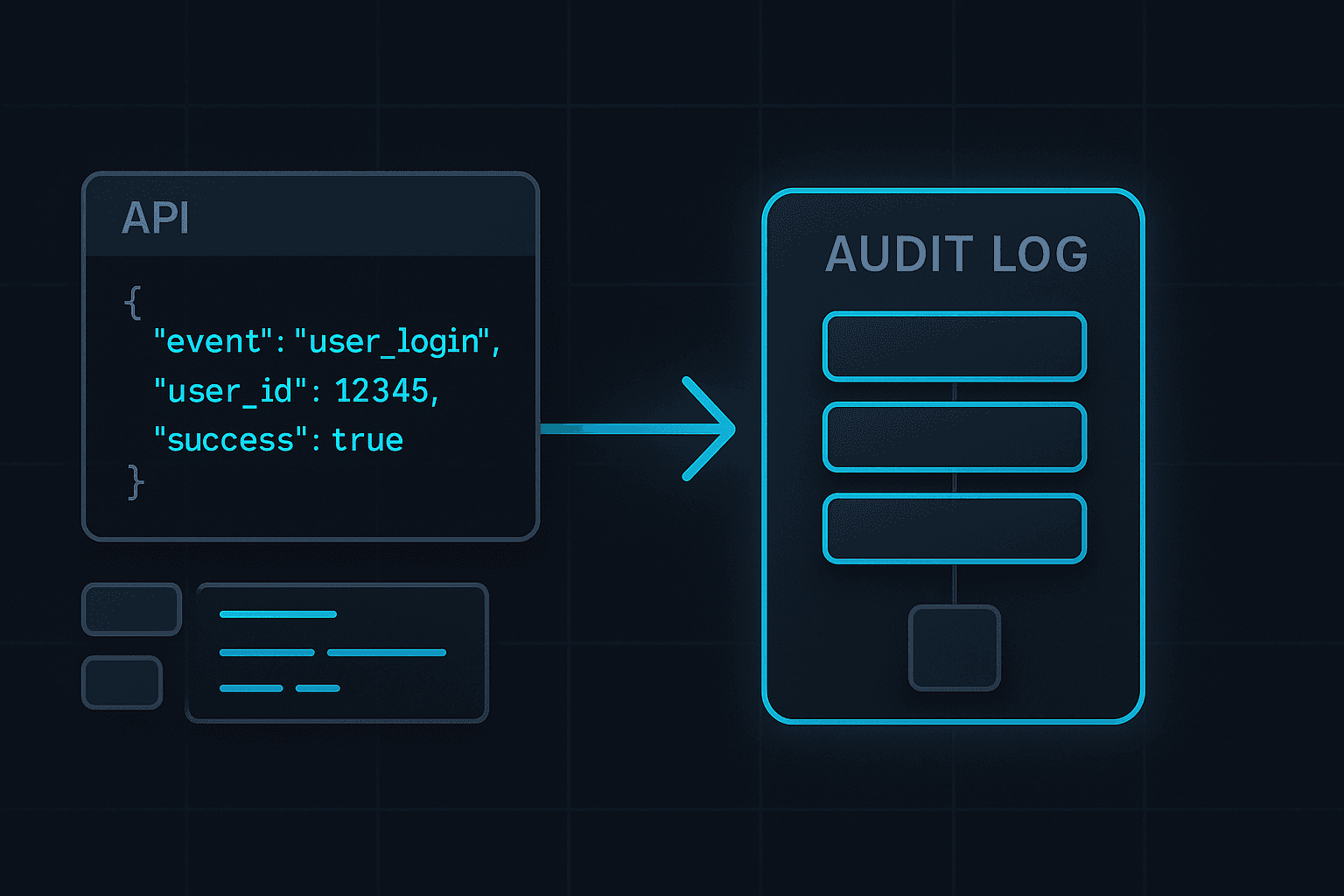
Developers should immediately understand how to send an audit event without reading a long manual. A simple POST endpoint for event ingestion is usually the foundation:
POST /v1/events
The request body must be:
- JSON
- Predictably structured
- Strictly validated
- Consistent across all event types
A developer should be able to send an audit event with minimal guesswork.
2. A well defined event model
The audit API must provide a consistent event schema. Developers should never ask themselves what fields are required or how to represent a specific action. While different organisations need flexibility, an audit API should define a recommended core schema such as:
- actor
- action
- resource
- timestamp
- context
- metadata
- request information
A solid event model is the difference between a coherent audit history and a scattered set of random logs.
3. Strong validation with meaningful error messages
Poorly designed systems accept malformed events and store incomplete or incorrect data. A developer friendly API rejects bad data but explains why.
Good validation includes:
- Clear error messages
- Accurate type checking
- Helpful suggestions
- Human readable explanations
- Consistent formats
The developer should know exactly what to fix.
4. Flexible client libraries and SDKs
Many teams prefer to integrate through SDKs rather than raw API calls. A developer friendly audit trail API provides SDKs in common languages:
- JavaScript and TypeScript
- Python
- Go
- Java
- Ruby
- PHP
- .NET
SDKs should include:
- Typed client methods
- Automatic retries
- Request signing or authentication handling
- Built in validation
- Safe defaults
The SDK should be the fastest way to get started.
5. Excellent documentation
Documentation is often more important than the API itself. Developers should be able to find what they need within seconds.
High quality documentation includes:
- Getting started examples
- Code samples for every language
- Clear description of event structure
- Authentication examples
- Best practices and anti patterns
- Troubleshooting
- Common integrations
- Copy and paste templates
The goal is to reduce ambiguity and increase confidence.
6. Safe and predictable authentication
Audit APIs often rely on API keys. A developer friendly system must support:
- Easy key creation
- Different scopes
- Revoke and rotate workflows
- Workspace or project level keys
- Granular permissions
Keys should never be tied to a single developer. They belong to the system.
7. High reliability and durability
Developers need assurance that events sent to the API will not disappear. A well designed system provides:
- Durable storage
- Hash chained immutability
- Strong consistency guarantees
- Redundant write paths
- Back pressure handling
- Write acknowledgments
If an event cannot be lost, the API must behave accordingly.
8. Clear rate limits and quotas
Developers should know:
- How many events per second are allowed
- How burst capacity works
- What happens when limits are exceeded
Rate limits must be documented and return predictable responses.
9. Local development support
Developers often need to test applications locally. A great audit trail API provides:
- A local mock server
- A simple command line tool
- Sample data for testing
- Optional in memory mode
Local support accelerates adoption.
10. First class error handling
The API should return structured error objects such as:
``json { "error": { "code": "INVALID_EVENT", "message": "The field 'actor.id' is required", "docs": "https://docs.hyrelog.com/errors/invalid-event" } } ``
This prevents guesswork.
Building a Consistent Event Experience
Beyond ingestion, the audit API should empower developers to structure events effectively. This includes helping them:
- Define a consistent action naming convention
- Create resource identifiers
- Represent before and after states
- Decide which metadata belongs in events
- Enforce minimal fields
The goal is not maximum freedom. It is predictable structure. Predictability turns logs into evidence.
Making Integrations Easy and Fast
Developers should be able to instrument an application within minutes. That means providing:
Copy and paste examples
Clear examples for every event type.
Middleware and framework integrations
Such as:
- Express
- Fastify
- Django
- Flask
- Rails
- Spring Boot
- Next.js
When integrations are seamless, adoption accelerates.
Templates for common event types
Such as:
- User login
- Permission change
- Record edit
- Export action
- Configuration update
Templates help teams avoid inconsistent event design.
Designing for Scale and Performance
A developer friendly audit trail API must handle:
- High write throughput
- Event bursts
- Millions of events per day
- Parallel ingestion across microservices
Developers should not need to architect around the limitations of the audit platform.
Building Trust Through Transparency
Trust is essential. Developers will only rely on an audit trail API if they understand how it works.
Transparency includes:
- Clear documentation on immutability
- How hash chaining works
- Retention policies
- Exactly how events are stored
- Guarantees around tampering detection
- Data residency location
- SLAs and reliability guarantees
Trust is earned, not assumed.
The Path to a Truly Developer Friendly Audit Trail API
Building a developer friendly audit trail API requires attention to detail. It must be:
- Clear
- Predictable
- Reliable
- Intuitive
- Well documented
- Pleasant to use
When these qualities are met, the audit trail platform becomes part of the development foundation. Teams gain confidence that every action carried out in a system is recorded with accuracy and integrity. They gain faster debugging, better compliance evidence, stronger security posture, and improved visibility.
Above all, the right audit trail API enables developers to focus on building products, not reinventing audit logging.
Conclusion
A developer friendly audit trail API is not merely a technical convenience. It is an operational and compliance enabler. It helps organisations build more trustworthy systems and improves the experience of the teams responsible for implementing critical logging.
The best APIs are the ones developers want to use. They are simple, reliable, and thoughtfully designed. They do not force developers to fight complexity or guess at the correct structure. By focusing on developer experience, organisations can implement audit logging that is both robust and widely adopted.
If you are building an audit trail system or evaluating platforms, start by asking a simple question: Would a developer enjoy using this API, or would they avoid it? The answer determines the success of the entire logging strategy.