Audit Trails vs Observability: Why Both Matter in Modern Systems
Understanding the differences between logs, traces, metrics, and immutable audit records
Audit trails and observability logs are not interchangeable. Learn the critical differences, when to use each, and how audit trails complement your observability stack.
Audit Trails vs Observability: Why Both Matter in Modern Systems
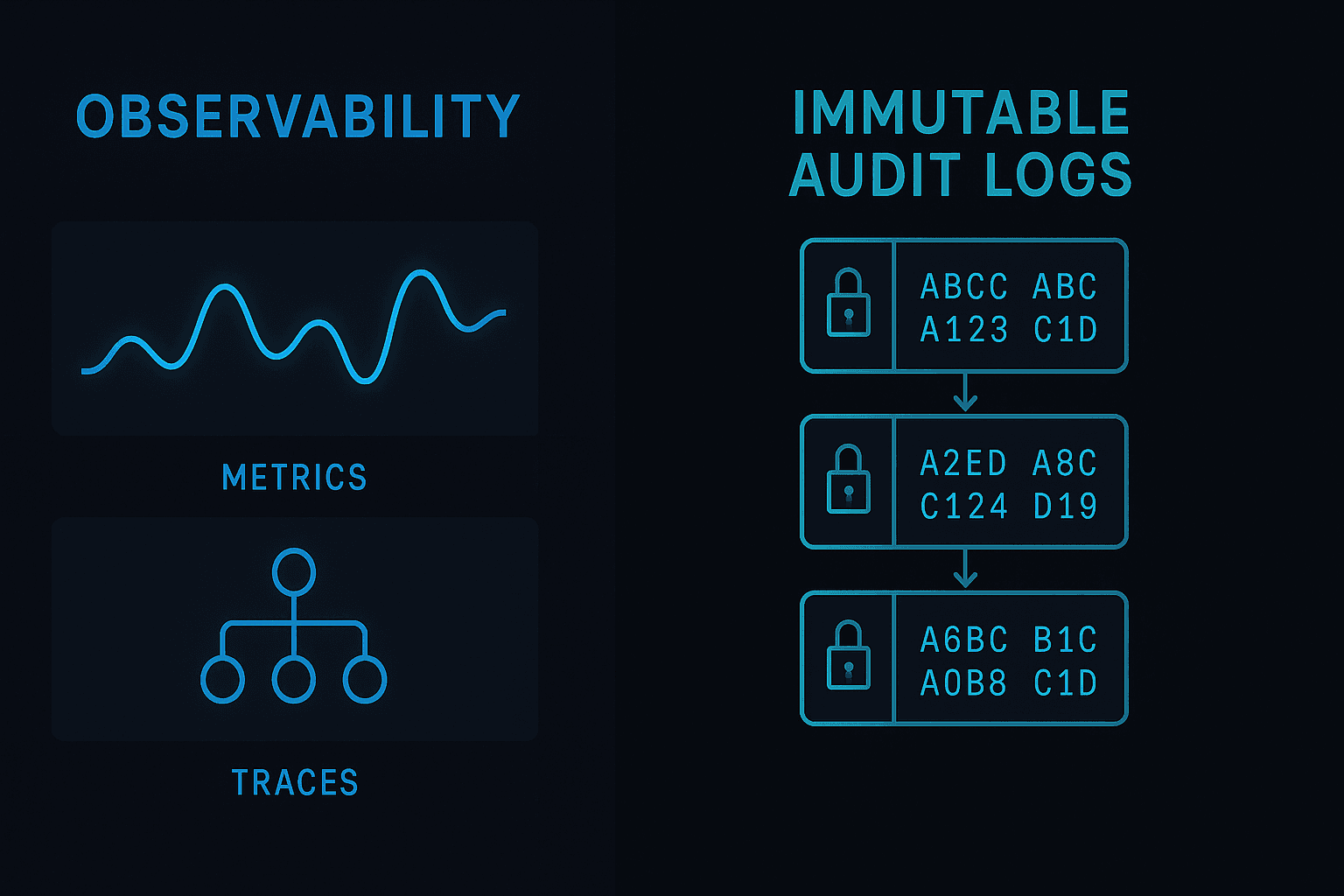
Audit trails and observability logs often get confused, but they solve very different problems. Both are important. Both record information. But one is designed for _incident response and operational awareness_, while the other is designed for _legal accountability, compliance, and forensic truth_.
In this article, we break down the differences across security, architecture, compliance, and engineering workflow, and explain why modern systems need both.
---
What Is Observability?
Observability is the ability to understand the internal state of a system using logs, metrics, and traces. It answers questions such as:
- Why is this service slow?
- What caused this spike in errors?
- Where did the request fail?
- Which part of the system is bottlenecking?
Observability is built for debugging, performance analysis, and system health.
The Three Pillars
Unstructured or structured text messages output by applications.
Numeric time-series values that show trends (CPU, latency, throughput, queue depth).
A request’s journey through a distributed system.
Observability tools (Datadog, New Relic, Honeycomb, Grafana) help engineers identify root causes and ensure reliability.
But here’s the key: Observability data is rarely immutable, trustworthy evidence of user actions. And it’s not meant to be.
---
What Are Audit Trails?
Audit trails are chronological, structured, tamper-evident records of business-relevant events:
- User logins
- Permission changes
- Data exports
- Admin actions
- Financial events
- Security-sensitive operations
Audit trails must be:
- Immutable
- Trustworthy
- Legally defensible
- Verifiable
- Accessible for investigations
Unlike observability logs, audit trails are designed to answer:
- Who accessed the data?
- What did they change?
- Why was this action performed?
- When did this security-sensitive event occur?
- Can we prove the event record hasn’t been altered?
---
Observability Helps Engineers.
Audit Trails Protect the Business.
A powerful way to understand the difference is this:
| Purpose | Audit Trails | Observability | | ------------------------------- | ------------ | ------------- | | Security investigations | ✔ | △ | | Compliance + certifications | ✔ | ✘ | | Debugging + root-cause analysis | △ | ✔ | | Performance monitoring | ✘ | ✔ | | Legal evidence | ✔ | ✘ | | Detecting suspicious access | ✔ | △ | | Infrastructure failures | ✘ | ✔ |
They overlap, but don’t replace each other.
---
Why Observability Can’t Replace Audit Trails
Even mature observability stacks fall short for compliance and investigations:
1. Logs Are Not Immutable
They may be stored in files, overwritten, deleted, or lost during rotation.
Audit trails must be tamper-evident (hash chains, signatures).
2. Observability Is Infrastructure-Centric
Logs focus on system behaviour:
2025-02-01 ERROR Timeout calling service B
Audit trails focus on business behaviour:
User 124 changed role from viewer → admin at 2025-02-01 09:22 UTC
3. Observability Data Ages Out
Log retention is often days or weeks. Audit trails must survive years.
4. Observability Data Is Volatile
Infrastructure changes → logs lost. Containers restart → logs gone. Microservices split → logs fragment.
Audit trails must be durable, portable, and centralised.
---
Why Audit Trails Can’t Replace Observability
Audit trails contain business events, not performance or debugging data.
They don’t track:
- CPU spikes
- Latency patterns
- Error rates
- Request traces
- Memory leaks
Observability keeps systems healthy. Audit trails keep organisations accountable.
---
Together: A Complete Trust & Reliability Story
A modern system needs:
Observability
to keep systems running.
Audit trails
to keep organisations compliant, secure, and trustworthy.
When combined, engineers and security teams gain:
- Root-cause understanding
- Clear accountability
- Traceability across business + technical events
- Real-time anomaly detection
- Forensic-grade evidence
---
Building a Dual-Layer Strategy
1. Use Observability Tools for Infrastructure
Datadog, Grafana, Honeycomb, Sentry.
2. Use HyreLog for Audit Trails
HyreLog provides:
- Hash-chained immutability
- Fast ingestion
- Workspace + project scoping
- Clean querying
- Forensic evidence
- Exportable timelines
Together, they unlock complete visibility across both systems and actions.