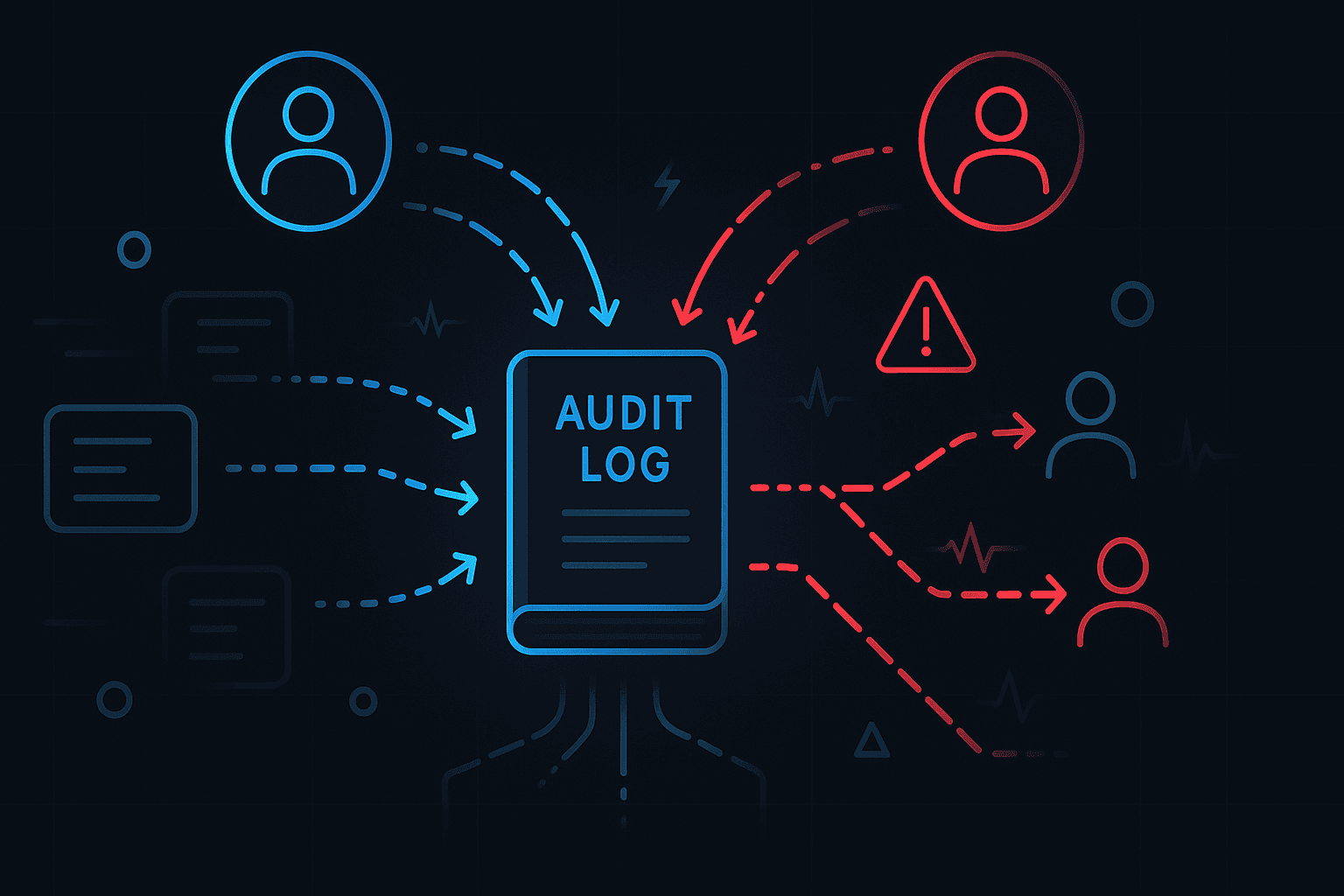
The Role of Audit Trails in Insider Threat Detection
How reliable event history helps uncover malicious or risky insider actions
A detailed examination of how audit trails support insider threat detection, behavioral analysis, and rapid response in modern environments.
The Role of Audit Trails in Insider Threat Detection
Insider threats are one of the most serious and complex risks faced by modern organisations. Many teams focus their attention on external attackers, but breaches, data misuse, and operational disruption are often caused by individuals within the organisation who already have legitimate access. These insiders may be employees, contractors, service providers, or any user with system credentials.
Detecting insider threats requires visibility into actions that occur inside systems. Firewalls and intrusion detectors are useful, but they cannot reveal which employee exported customer data, who changed permissions, or who accessed sensitive records repeatedly after hours. This level of visibility only comes from a reliable and complete audit trail.
A strong audit trail is not just a compliance tool. It is one of the most important defensive mechanisms for understanding human activity inside a system and for recognising patterns that might indicate malicious intent, negligence, or compromised accounts. This article explores how audit trails support insider threat detection, how to design them effectively, and what organisations should consider when building or adopting an audit logging solution.
Understanding Insider Threats
Insider threats generally fall into three categories.
Malicious insiders
These are users who intentionally misuse their access for personal gain, revenge, coercion, or outside influence. They may exfiltrate data, sabotage systems, delete records, or escalate privileges.
Negligent insiders
These threats arise when well meaning employees make mistakes that lead to breaches or data exposure. Examples include sending sensitive files to the wrong recipient, misconfiguring permissions, or using weak authentication practices.
Compromised insiders
These occur when legitimate accounts have been taken over by external attackers. The attacker inherits the user’s permissions and can impersonate normal behaviour while carrying out harmful actions.
Across all three categories, the key factor is that the activity originates from a position of trust within the system. This means traditional perimeter based security is insufficient. Instead, organisations require deep visibility into user actions.
Why Audit Trails Are Critical to Insider Threat Detection
Audit trails solve a core problem in insider threat detection: the ability to observe, measure, and verify user actions. Without this, it is impossible to distinguish normal behaviour from suspicious activity.
Complete visibility into actions
Audit trails capture detailed events such as:
- data access events
- permission changes
- failed authentication attempts
- administrative actions
- data exports
- configuration changes
- record modifications
This visibility allows analysts to trace actions precisely to specific users.
Detecting anomalies and unusual patterns
Insider threats often involve behavioural patterns rather than isolated events. Audit logs allow detection of:
- repeated access outside normal hours
- unusual volume of sensitive record views
- actions inconsistent with a user’s role
- sudden privilege escalations
- unexpected administrative activity
- suspicious sequences of actions
These patterns are difficult to detect without structured, queryable event data.
Supporting attribution and accountability
If an incident occurs, audit logs provide authoritative evidence of:
- who performed the action
- what was done
- when it occurred
- from where it originated
This reduces ambiguity in investigations and provides confidence in the accuracy of findings.
Providing evidence for legal, HR, and compliance processes
Many insider threat scenarios lead to disciplinary, legal, or regulatory consequences. Audit logs create a defensible evidence trail that supports the organisation’s case and protects it from challenges.
Accelerating incident response
Insider threat response requires quick and confident decision making. Audit trails allow responders to reconstruct the full timeline of events, helping them contain the threat before damage spreads.
What an Effective Insider Threat Audit Trail Should Capture
Not all logs are equally useful for detecting insider threats. To build a high quality audit trail, organisations should capture the following attributes for each event.
Actor
Who performed the action, including:
- user ID
- session identifier
- authentication method
- device or agent
- IP address
Action
A clear description of the user’s behaviour, such as:
- viewed customer record
- exported data
- deleted file
- changed permission
- created new user
Target
What the action applied to, including resource type and unique identifiers.
Timestamp
High precision timestamps allow investigators to sequence events accurately.
Result
Whether the action succeeded or failed.
Context
Relevant supporting data such as:
- location
- previous state values
- reason codes
- system or integration origin
This enhances analysis and provides clarity during investigations.
Hash Chaining and Integrity for Insider Threat Logs
Insider threats may include attempts to cover tracks by modifying or deleting logs. Therefore, integrity controls are essential. Hash chaining ensures tamper evident logs by linking each entry to the previous one using cryptographic hashing.
If any entry is altered, the chain breaks, revealing tampering.
This is critical because:
- malicious insiders often know where logs are stored
- system administrators are potential insider threats themselves
- forensic evidence must be defensible
- compliance frameworks require unaltered records
A proper hash chained audit trail makes it nearly impossible to falsify history without detection.
How Audit Trails Support Insider Threat Detection Workflows
Baseline behavioural analysis
Audit logs can establish normal usage baselines for roles, departments, and individuals. Deviations from these baselines may indicate risk.
Automated alerting
Security systems can generate alerts based on audit events that match known indicators, such as:
- unusual volume of access
- privilege escalation followed by data export
- repeated failed access attempts
- access from new geographic regions
Correlation with other systems
Audit logs are essential inputs for SIEM, UEBA, and incident response tools. They enrich alerts with user specific details.
Supporting human analysts
Even in organisations with automated detection, human analysts rely on audit trails to confirm, dismiss, or escalate incidents. Clear, structured logs reduce time spent searching for relevant evidence.
Case Studies Illustrating the Importance of Audit Trails
Privilege abuse by administrator
In many organisations, administrators have broad access privileges. Without detailed audit logs, it is almost impossible to know when these privileges are abused. In cases where administrators accessed sensitive HR or customer data without a legitimate purpose, audit trails became the only evidence used to identify and remove them.
Data exfiltration by departing employee
An employee planning to leave a company may attempt to extract customer lists or intellectual property. Well designed audit trails have identified:
- suspicious download activity
- large exports before resignation
- deletion of activity logs
- off hour data access
These clues allow early detection and mitigation.
Compromised accounts
Audit logs have been essential in identifying fraud where attackers used employee credentials to access financial systems. Suspicious sequences of actions, irregular timing, and inconsistent device fingerprints were identified through log analysis.
Designing Audit Trails for Insider Threat Programs
Organisations should consider the following design principles:
Centralised logging
Logs should be centralised in a secure location separate from application infrastructure. This prevents local tampering.
Normalised event formats
Events should follow a consistent schema to support automated detection.
Scalable storage
Insider threat detection requires storing significant amounts of historical data. Systems should scale with event volume.
Role based access controls
Only authorised analysts should be able to view or export logs. Even administrators should have restrictions.
Retention policies
Insider threat investigations often involve long look back periods. Logs should be kept based on regulatory and operational requirements.
Encryption
Data at rest and in transit must be encrypted.
Monitoring and alerting
Audit logs should integrate with SIEM, SOAR, and analytics systems.
Conclusion
Insider threats remain one of the most difficult security challenges for modern organisations. Attackers may operate with legitimate credentials, minimal external signals, and knowledge of system design. Audit trails provide the visibility and integrity required to detect these threats, investigate incidents, and strengthen organisational security.
By collecting structured, tamper evident, and comprehensive event data, teams can identify malicious activity more quickly and respond with confidence. Audit trails do not eliminate insider threats, but they significantly reduce the organisation’s exposure by ensuring that every critical action leaves a trace.