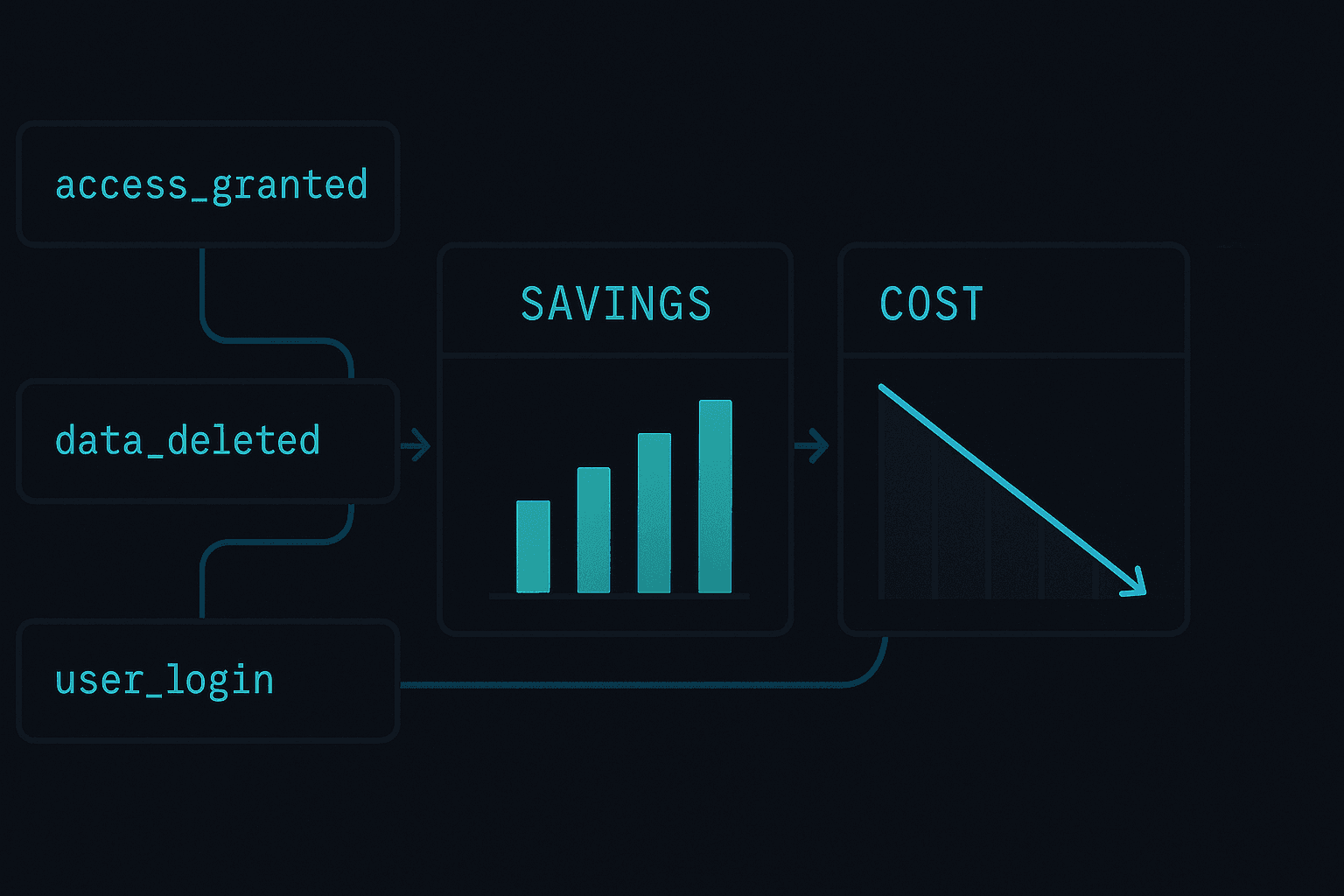
How Audit Trails Reduce Operational Costs Across the Entire Organisation
The hidden ROI of structured audit logging for support, engineering, security, compliance, and product teams
Audit trails don’t just improve security, they reduce operational costs across support, engineering, compliance, and product. Learn how implementing a dedicated audit layer saves money and time.
How Audit Trails Reduce Operational Costs Across the Entire Organisation
Most organisations think of audit trails as a “compliance cost.” In reality, they’re a cost-saving mechanism that reduces operational overhead across every team, from support to engineering to product to compliance.
A proper audit trail does not just capture what happened. It reduces the number of incidents, shortens resolution time, improves collaboration, enhances user trust, and eliminates hundreds of hours of manual work.
This article explores the real, measurable operational savings that structured audit trails create.
---
1. Reduced Customer Support Investigation Time
Support teams spend enormous time answering questions like:
- “Why can’t I log in?”
- “Who deleted this record?”
- “Why did my permissions change?”
- “How did this configuration get updated?”
Without a proper audit trail, each support ticket becomes an investigation.
With audit trails:
Support agents can instantly answer:
- Who performed the action
- What changed
- When it happened
- How the system interpreted the request
Realistic Cost Reduction:
- Up to 70–90% faster investigation times
- Fewer escalations to engineering
- Reduced ticket backlog
- Lower SLA breach rates
Support becomes a _first-line resolver_ rather than an escalation engine.
---
2. Engineering Debugging Time Drops Dramatically
Engineering is the most expensive resource in any technology company.
When something goes wrong, engineers often spend hours digging through:
- Application logs
- Cloud logs
- Server traces
- Console output
- Database entries
- Slack messages
- Customer reports
Audit trails centralise the truth.
Engineers can answer:
- What sequence of actions led to the issue?
- Did a user or system trigger the behaviour?
- Was the change intentional or accidental?
- Which service made the request?
Engineering Time Savings:
- Debugging reduced from hours to minutes
- Fewer “ghost bugs”
- Less time spent reading logs
- Fewer multi-team investigations
These savings compound massively over a year.
---
3. Compliance Workload Shrinks Significantly
Preparing for SOC 2, ISO 27001, PCI DSS, or GDPR audits involves:
- Gathering evidence
- Proving access controls
- Demonstrating change history
- Providing incident timelines
- Showing data governance
Without an audit trail, compliance teams must manually gather proof.
With audit trails:
Compliance becomes _self-documenting_.
- Evidence is automatically generated
- Actions are timestamped and immutable
- Change history is always available
- Role changes, permissions updates, and exports are logged
Compliance Savings:
- Weeks of prep reduced to hours
- Fewer repeat requests to engineering
- Reduced audit fatigue
- Lower error rates
- Smoother annual recertification
Compliance becomes predictable, not painful.
---
4. Incident Response Costs Drop Dramatically
Incident response requires reconstructing a timeline.
Without audit logs:
- Teams guess
- Logs conflict
- Systems misalign
- Human memory becomes the source of truth
- Investigations stall
With audit logs:
Teams can instantly see:
- Who accessed what
- What they changed
- Whether data was exported
- Whether permissions escalated
- Where suspicious activity originated
Cost Reductions:
- Faster containment
- Narrower blast radius
- Better communication with affected customers
- Lower regulatory risk
- Reduced engineering hours during emergencies
In a breach scenario, hours saved = millions saved.
---
5. Internal Governance Improves (Reducing Risk Costs)
A surprising cost driver? Internal errors.
Many organisations experience:
- Unapproved admin actions
- Accidental deletions
- Data exports done by mistake
- Misconfigured permissions
- Changes without documentation
Audit trails reduce governance-related mistakes by:
- Increasing accountability
- Providing traceability
- Creating a visible change history
- Detering unauthorised behaviour
- Preventing accidental misconfigurations
Risk Savings:
- Fewer costly data errors
- Smoother handover between teams
- Better control during staff turnover
- Complete visibility for leadership
---
6. Product Teams Make Better Decisions (Reducing Iteration Waste)
Bad product decisions are expensive.
Audit trails reveal:
- What users actually do
- Which features are misunderstood
- Which permissions cause friction
- How admins configure systems
- Which actions generate support tickets
Better insights = fewer wasted sprints.
Product Savings:
- Reduced rework
- Clearer prioritisation
- Better onboarding flows
- Faster iteration
- Reduced UX confusion
Product decisions become data-driven rather than assumption-driven.
---
7. Reduced Legal Costs and Liability Risks
When disputes arise:
- “Your system deleted my data.”
- “We didn’t approve this change.”
- “Your platform mis-handled our records.”
Audit trails provide legal evidence.
Without them, companies face:
- Costly disputes
- Inability to defend actions
- Liability risk
- Damaged reputation
With audit logs:
- Clear evidence
- Timelines
- Accountability
- Proven integrity
Legal Savings:
- Shorter disputes
- Lower settlement costs
- Stronger defensibility
---
8. Lower Infrastructure and Logging Costs
Most teams over-log because they don’t have structured, business-level audit logging.
They store:
- Application logs
- Infrastructure logs
- Access logs
- Debug logs
These logs grow endlessly, and expensively.
A dedicated audit trail reduces the need for noisy logs by capturing the _business events that matter_.
Infrastructure Savings:
- Fewer logs stored
- Less search overhead
- Reduced retention costs
- Lower cloud spend
Audit trails are cheaper than unlimited logging ingestion.
---
9. Developers Stop Rebuilding Audit Frameworks
Every engineering team eventually builds:
- A logging wrapper
- Event schema
- Hash chains
- Database tables
- Export tools
- Dashboard views
- Query endpoints
- Retention systems
- Compliance logic
This takes months, and is rarely correct.
With a solution like HyreLog, teams save:
- Engineering time
- Maintenance overhead
- Operational burden
- Compliance rework
Estimated Savings:
- 2–4 months of engineering work avoided
- Reduced architectural mistakes
- Reduced cryptographic errors
- Immediate compliance alignment
---
Conclusion: Audit Trails Pay For Themselves
Audit trails are not a compliance tax, they’re an operational cost-reduction engine.
They reduce:
- Support investigation time
- Engineering debugging
- Incident response burden
- Compliance evidence gathering
- Product rework
- Internal governance mistakes
- Infrastructure logging costs
- Legal disputes
- Engineering rebuild time
Across a year, organisations can save:
- Hundreds of hours
- Hundreds of thousands in operational cost
- A significant amount of engineering velocity
Audit trails are ROI-positive infrastructure, not an obligation.
And a dedicated service, like HyreLog, makes them simple, scalable, and reliable.